Senka Perfect Whip: The Complete Guide to Japan's Best Selling Cleanser

cleansersenkaguide

Quick Takeaway

  • Japan’s top selling cleanser for over a decade. Senka Perfect Whip has held the #1 spot in its category for years, with thousands of reviews on @cosme and LIPS. It costs ¥498 to ¥698 (roughly $4 to $5) depending on the variant.
  • Famous for its foam. The dense, cushiony lather is genuinely impressive and unlike most Western cleansers. Lab testing by My-best praised the foam quality and density.
  • But it’s polarizing. The r/AsianBeauty community voted it out first in a cleanser elimination game with over 1,100 negative votes, calling it too stripping and drying. This is a real concern for dry and sensitive skin types.
  • Five variants exist, not three. Original, Collagen In, White Clay, Acne Care (medicated), and Speedy (pump foam). Each targets a different skin concern.
  • Now made by Fine Today, not Shiseido directly. The brand transferred when Shiseido spun off its daily necessities division in 2021.

Senka Perfect Whip is one of those products where the reputation splits cleanly down the middle. In Japan, it’s a household name with massive sales numbers. In international skincare communities, it’s become a cautionary tale about high pH cleansers. Both sides have a point, and understanding why requires looking at what this cleanser is, what it isn’t, and who it’s built for.

This guide covers all five variants, breaks down the ingredient formula, addresses the stripping controversy honestly, and helps you figure out whether any version of Perfect Whip belongs in your routine. (For a broader look at the category, see our best Japanese face wash roundup.)


The Brand: Senka and Fine Today

A quick note on who makes this product, because most English language sources get it wrong.

Senka was originally a Shiseido brand, part of their affordable drugstore lineup. In July 2021, Shiseido spun off its personal care and daily necessities business into a separate company called Fine Today (ファイントゥデイ). Senka, along with other mass market Shiseido brands like Tsubaki and Macherie, moved to Fine Today.

Fine Today still uses Shiseido’s research and manufacturing infrastructure, and the products haven’t changed. But technically, your tube of Perfect Whip is a Fine Today product, not a Shiseido product. You’ll still see “Shiseido” on older packaging and in many retail listings. The formulas remain the same.


What Makes the Foam Special

The signature selling point of Perfect Whip is the foam texture. It’s not the typical thin, airy lather you get from most tube cleansers. It’s dense, elastic, and heavy enough to hold its shape. Japanese consumers describe it as もちもち (mochi mochi), meaning it has that sticky, bouncy quality similar to rice cake.

This foam density isn’t just marketing. My-best, a Japanese product testing site, evaluated Perfect Whip against dozens of other cleansers using standardized lab equipment. The foam quality and density scored well in their testing. The lather is genuinely different from what most other drugstore cleansers produce.

Why does it foam like this? The primary surfactants are myristic acid and palmitic acid, both soap-based cleansing agents. When combined with potassium hydroxide (the alkalizing agent in the formula), they produce a rich, stable lather with fine bubbles. The tradeoff is that this soap chemistry creates a high pH wash, which is where the controversy starts.


Ingredient Breakdown

Here’s what’s doing the work in the Original formula:

Cleansing agents: Myristic acid and palmitic acid are the core surfactants. These are fatty acid soaps, the same chemistry behind traditional bar soap but in a tube format. They’re effective at removing oil, makeup residue, and surface impurities, but they produce an alkaline pH (estimated around 8 to 9).

Moisture ingredients: The formula includes sodium hyaluronate and acetyl hyaluronate (often marketed as “W hyaluronic acid” or double hyaluronic acid). These are meant to offset some of the drying effect of the soap base. The formula also contains glycerin for basic hydration.

Silk essence (Sericin): Senka’s signature ingredient. Sericin is a protein derived from silk cocoons, used as a conditioning and film-forming agent. It gives the post-wash skin a smoother feel, though its moisturizing effect is mild compared to dedicated hydrating ingredients.

The bottom line: this is a soap-based cleanser dressed up with hydrating and conditioning ingredients. The foam is excellent, the cleansing power is strong, and the moisturizing additions help, but they don’t fully counteract the drying potential of the high pH base. This matters for some skin types more than others.


The Stripping Controversy: Let’s Be Honest

Perfect Whip has a well documented reputation in international skincare communities for being too stripping. The most cited moment: in r/AsianBeauty’s cleanser elimination game, Perfect Whip was voted out first with 1,106 net negative votes (1,152 negative against just 46 positive). Users compared the post-wash feeling to “dish soap” and described tightness, dryness, and irritation.

This isn’t just internet drama. There’s a real chemical reason behind it.

The pH problem. Soap-based cleansers using myristic acid and potassium hydroxide produce a lather with a pH around 8 to 9. Your skin’s natural pH sits around 4.5 to 5.5. That’s a significant gap. Repeated exposure to high pH cleansing can temporarily disrupt the skin’s acid mantle, the protective barrier that keeps moisture in and irritants out. For people with already dry, sensitive, or compromised skin, this disruption can cause tightness, flaking, and reactive breakouts.

The lab data. My-best’s testing found that Perfect Whip scored well on cleansing power and foam quality. However, their moisture retention tests showed mixed results depending on the version tested, with some formulations performing below average for skin hydration after washing. The cleansing works, but the moisture cost can be higher than average for soap-based formulas like this.

Who should avoid it: If you have dry skin, sensitive skin, eczema-prone skin, or a compromised moisture barrier, Perfect Whip is probably not for you. The foam feels luxurious, but the after-effect on moisture-deprived skin isn’t worth it.

Who it works for: Normal to oily skin types, especially those who live in humid climates or produce a lot of sebum. If your skin is resilient and you want a thorough, satisfying cleanse that leaves your face feeling genuinely clean (not just “cleanser-slippery”), Perfect Whip delivers. Thousands of Japanese consumers with oily and combination skin repurchase this product for years without issues.

The key takeaway: this is a polarizing product because skin types are different, not because the product is bad. Know your skin, and choose accordingly.


All Five Variants

The Japanese lineup includes five Perfect Whip variants. Most international retailers only carry the Original, and many guides (including our original version of this article) only covered three. Here’s the full range with current Japanese retail pricing.

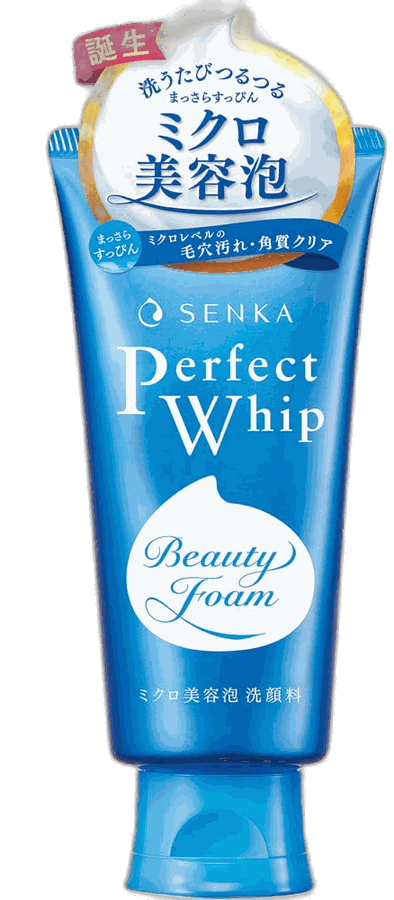
Original (Blue Tube) | ¥498

Senka Perfect Whip

The flagship. Dense foam, strong cleansing power, silk essence and double hyaluronic acid. Best for normal to oily skin. This is the variant with the highest sales volume and the most reviews (over 2,300 on @cosme alone). It’s the one people are referring to when they say “Perfect Whip” without specifying.

Best for: Normal to oily skin, anyone who wants the fullest foam experience.

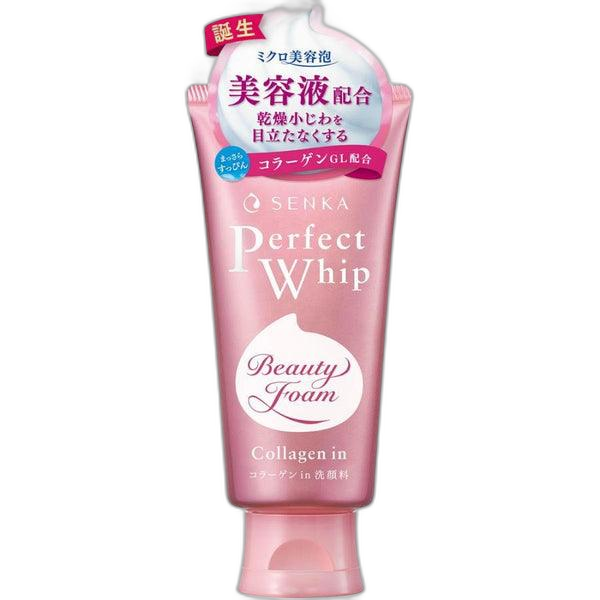
Collagen In (Pink Tube) | ¥598

Senka Perfect Whip Collagen

Same foam base with added water-soluble collagen, an extra moisturizing sugar complex, and the standard double hyaluronic acid. The goal is a less drying wash with some plumping benefit. Japanese user reviews note that while there’s still a slight tightness immediately after washing, the skin feels more supple a few minutes later compared to the Original.

Best for: Normal to dry skin, those who want the Perfect Whip foam with less moisture loss.

White Clay (Green Tube) | ¥658

Senka Perfect Whip White Clay

Formulated with kaolin (white clay) and charcoal for enhanced pore cleansing. The clay and charcoal work as physical adsorbents, drawing out sebum and blackhead-causing buildup. Japanese reviews consistently praise it for reducing the rough, grainy texture (ザラザラ感) around the nose. This is the strongest cleansing option in the lineup.

Best for: Oily skin, clogged pores, blackheads, rough texture.

Acne Care (Light Blue Tube) | ¥658

Senka Perfect Whip Acne Care

This is a medicated (薬用) product, which means it’s classified as a quasi-drug in Japan and contains a regulated active ingredient: dipotassium glycyrrhizinate (グリチルリチン酸ジカリウム), a licorice-derived anti-inflammatory. It targets adult acne by reducing inflammation while cleansing. Japanese reviews rate it highly (3.5 to 4.0 on @cosme with over 570 reviews depending on the listing), with users noting that it manages breakouts without the aggressive tightness typical of acne cleansers.

Best for: Breakout-prone skin, hormonal acne, pre-period flare-ups.

Speedy (Pump Bottle) | ¥698

The only variant that comes pre-foamed in a pump dispenser. Press the pump, get foam, wash your face. No lathering required.

The convenience is real, but the foam texture is different. Users describe it as lighter and more airy than the tube versions, lacking the dense もちもち quality that makes Perfect Whip distinctive. Think of it as a convenience tradeoff: faster but less satisfying. Japanese reviews are mixed compared to the tube versions.

Note: This variant is not in our product database yet. It’s available at Japanese drugstores and on Amazon Japan.

Best for: Morning routines, time-pressed washing, anyone who dislikes hand-lathering.


How to Use (and the Foaming Net)

Basic Method

  1. Wet your hands and face with lukewarm water
  2. Squeeze about one centimeter of product onto your palm
  3. Add a few drops of water and work the product between your palms for 15 to 20 seconds until you get a thick, dense foam
  4. Apply the foam cushion to your face, massaging gently without pressing hard
  5. Rinse thoroughly with lukewarm water

The Foaming Net (泡立てネット)

In Japan, many people use a small mesh net called an awadatenet (泡立てネット) to create foam. You squeeze the cleanser onto the net, add water, and work the net between your hands. The result is a noticeably denser, finer foam than you can achieve with palms alone, and you use less product per wash.

Foaming nets cost around ¥100 to ¥300 at Japanese drugstores and convenience stores. Daiso sells them. They’re also available on Amazon internationally. If you’re going to use Perfect Whip, a foaming net is worth trying. It makes the foam experience significantly better and stretches each tube further.

Tip: Replace your foaming net every 1 to 2 months. They’re breeding grounds for bacteria in humid bathrooms.


How It Compares

Here’s how Perfect Whip stacks up against common alternatives. This covers the products people most often compare it to.

Senka OriginalSenka CollagenSenka White Clay[[product:Hada Labo Gokujyun Foam]][[product:CeraVe Hydrating Cleanser]]
FormatTube (hand lather)Tube (hand lather)Tube (hand lather)Pump (pre-foamed)Tube (cream, no foam)
pH Range~8 to 9 (alkaline)~8 to 9 (alkaline)~8 to 9 (alkaline)~5 to 6 (mildly acidic)~5.5 (mildly acidic)
Skin TypeNormal to oilyNormal to dryOily, pore-proneAll types, gentleDry, sensitive
Key IngredientsMyristic acid, sericin, hyaluronic acidMyristic acid, collagen, hyaluronic acidMyristic acid, kaolin, charcoalAmino acid surfactants, hyaluronic acidCeramides, glycerin
Price (Japan)¥498¥598¥658~¥600N/A (imported)
Price (International)~$6 to $8~$7 to $9~$7 to $10~$8 to $12~$10 to $15
Foam QualityExcellent, denseExcellent, denseExcellent, denseGood, airyNone (cream texture)
Moisture ImpactModerate to high strippingModerate strippingHigh strippingLow strippingMinimal stripping

vs Hada Labo Gokujyun Cleansing Foam: If you love Perfect Whip’s foam but find it too drying, Hada Labo is the most common switch. The foam comes out of a pump pre-made, the pH is much lower, and it’s gentler on moisture levels. The foam isn’t as dense or satisfying as hand-lathered Perfect Whip, but the skin-friendliness tradeoff is worth it for most people.

vs d program Essence In Cleansing Foam: d program is the sensitive-skin specialist option. Much gentler than any Perfect Whip variant, but also more expensive (roughly double the price). If you’ve tried Perfect Whip and your skin reacted badly, d program is the direction to go.

vs [[product:CeraVe Hydrating Cleanser]]: Completely different product category. CeraVe is a non-foaming, cream-based cleanser designed for dry and sensitive skin. If you want foam and a “clean” feeling, CeraVe won’t deliver that. If you want gentle hydration and barrier support, CeraVe wins.


Japanese Market Context

Some numbers to put Perfect Whip’s popularity in perspective:

  • Senka has held the #1 cleanser spot in Japanese drugstore sales rankings for over 10 consecutive years. This is across all drugstore cleansers, not just foam types.
  • @cosme ratings across variants hover around 3.5/5, with the Acne Care version rated between 3.5 and 4.0/5 depending on the listing. For context, @cosme ratings tend to cluster between 3.0 and 5.0, so 3.5 is solidly average, reflecting the polarized opinions.
  • LIPS cosmetics reviews show similarly high engagement, with the Original averaging 4.3/5 across over 1,000 reviews.
  • My-best lab testing praised foam quality and cleansing power, though their moisture retention tests flagged some drying potential depending on the formulation version.

The takeaway: in Japan, this product dominates through a combination of low price, wide availability (every drugstore, supermarket, and convenience store carries it), and that genuinely impressive foam. Japanese consumers with oily and combination skin in a humid climate are the ideal audience, and they’re the bulk of the customer base.


Pricing

In Japan, Perfect Whip is a true budget product:

  • Original: ¥498 (roughly $3.50)
  • Collagen In: ¥598 (roughly $4)
  • White Clay: ¥658 (roughly $4.50)
  • Acne Care: ¥658 (roughly $4.50)
  • Speedy: ¥698 (roughly $5)

Internationally, prices run higher due to import and distribution costs. Expect to pay roughly $6 to $10 per tube from J-beauty specialty retailers. The Original is the most widely stocked variant outside Japan. Amazon, YesStyle, and Stylevana typically carry at least the Original and one or two variants.


FAQ

Why does Senka Perfect Whip feel stripping?

The primary surfactants are myristic acid and palmitic acid, soap-based cleansers that create a high pH lather (estimated pH 8 to 9). This strong cleansing action removes oil effectively but can strip the skin’s natural moisture barrier, especially on dry or sensitive skin. The post-wash tight feeling is the acid mantle recovering. If your skin takes more than a few minutes to feel normal after washing, the product is too harsh for your skin type.

Is it the same formula worldwide?

Not necessarily. The formula sold in Japan (the domestic version) may differ from versions manufactured for or sold in other markets like China, Southeast Asia, or global export. Always check the ingredient list on the back of your specific tube. The Japanese domestic version is the reference formula that Japanese reviews and lab tests are based on.

What is the pH of Senka Perfect Whip?

Independent testing estimates the pH at roughly 8 to 9, which is alkaline. For a soap-based cleanser, this is normal. For comparison, skin’s natural pH is about 4.5 to 5.5, and most modern low-pH cleansers (like those from Hada Labo or COSRX) target that range.

Is the pump version (Speedy) better?

It’s more convenient but less satisfying. The pre-foamed pump delivers a lighter, airier foam compared to the dense lather from the tube versions. Most Japanese reviews agree: the tube with a foaming net produces the best foam experience. The Speedy is best for mornings when you want a quick wash without the lathering step.

Which variant is best for acne?

The Acne Care variant (light blue tube). It contains dipotassium glycyrrhizinate, an anti-inflammatory active ingredient derived from licorice root. It’s classified as a quasi-drug (medicated product) in Japan. Japanese user reviews rate it the highest of all variants (3.5 to 4.0 on @cosme depending on the listing), with users praising it for reducing breakouts without excessive tightness.

Is Senka Perfect Whip good for everyday use?

For normal to oily skin, yes. Many Japanese users have used it daily for years without issues. For dry or sensitive skin, daily use is likely too much. Some people with combination skin use it only as their evening cleanser (especially after wearing makeup or sunscreen) and switch to a gentler cleanser in the morning.


Related: Japanese Skincare Routine for Beginners · Double Cleansing vs Single Cleansing · Best Japanese Skincare Brands